

Lyft
Lyft Product Language - Figma Enhancements
TLDR: I planned and executed a complex component refactor (49 components, thousands of variants) and oriented teams across Lyft PD+ around migration strategies. As a result, designers rapidly adopted the new components (climbed from 55% → 98% of total inserts). Detachments also fell 72%.
My involvement
I was the sole product designer tasked with overhauling our Figma component library, which had not received updates in almost a year. I assessed the current state of the library through an audit, created a normalized impact/effort rating (usage ÷ complexity) for each component to prioritize the work, and coordinated with DPMs to ensure widespread adoption and smooth rollouts of the new components once the work was done. Throughout the project, I provided digestible and entertaining videos detailing the improvements to the components, as well as how-to guides for things like Slot Components and Migration.
Once shipped and the legacy components were deprecated, systems users quickly adopted the new components (new component inserts vs legacy inserts climbed from 55% to 98% of total inserts). Detachments also fell 72% (3.08% → 0.87%).
Initial strategy: revolution or evolution?
As a new hire at Lyft, I was immediately tasked with overhauling our Figma component library.
The first challenge was deciding on an overall strategy. Should the changes be rolled out as they were completed, or should publishing wait until the entire project was done?
This project had been started by a previous designer, but he left before completing it, and the changes had not been published. In the time since the outgoing designer had left, Figma had majorly updated how components are built (most notably through component properties and exposing nested instances). In addition, Lyft designers had already been waiting for this project's completion for nearly a year.
Those factors made the choice clear to me — further delays would risk declining adoption and erosion of trust.
As long as changes were well-tested and value adds clearly communicated, we could actually build further trust and potentially jumpstart adoption with this project.
Evolving Lyft's Figma libraries through strategy, education, and cross-department coordination
Phase 1: Audit (or, "What even are these things?")
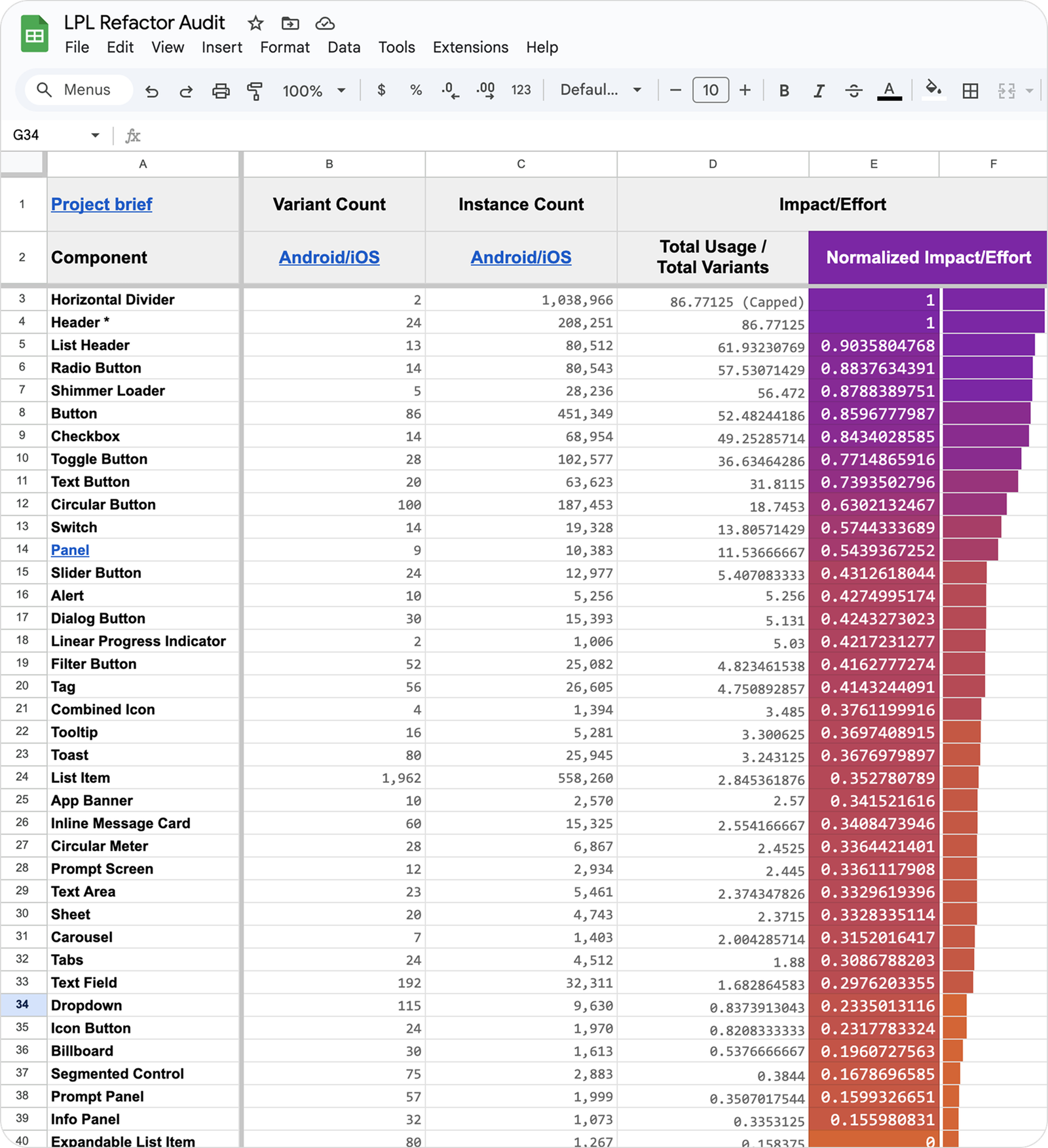
To gain context, I first analyzed the library and created a spreadsheet where each component's usage was divided by its variant count (a proxy measure for complexity). The result, once normalized, was a score from 0-1 that allowed me to prioritize work based on components that would have the highest impact for the lowest effort.
Phase 2: Evolution & Education (or, "Here are the things!")
Next, I outlined areas for improvement per-component and set to work. As this project represented 1/3 of my workload, I tasked myself with updating 3 components per week, with some exceptions for high-complexity components (I'm looking at you, List Item).
As updates were completed and published, I would also create digestible 3-5 minute videos demoing the new functionality, posting them to our #product-design Slack channel.
This worked like a charm — designers were energized and quite thankful for the steady trickle of updates.
This work continued for ~9 months before pivoting into migration mode.
Phase 3: Migration (or, "Please stop using those other things!")
The reality is that, for design-only updates, it is unrealistic and unnecessary to expect teams to migrate all of their work to new components. Most design files serve better as historical snapshots and don't require migration.
Instead of setting unreasonable expectations, at the project's outset I asked teams to identify 3-4 high-priority "source of truth" files by the EOY deadline and framed migration as a choice between two paths:
- 🐢 Tortoise Path: Migrate files gradually as updates arrive
- 🐇 Hare Path: Wait until all updates are complete before beginning migration
To incentivize Tortoises, I offered daily migration office hour signups during the component update cycle, and limited availability to 2x/week after that.
With every batch of component updates, I included robust migration guidance (both a textual/graphical guide, video guide, and FAQ).
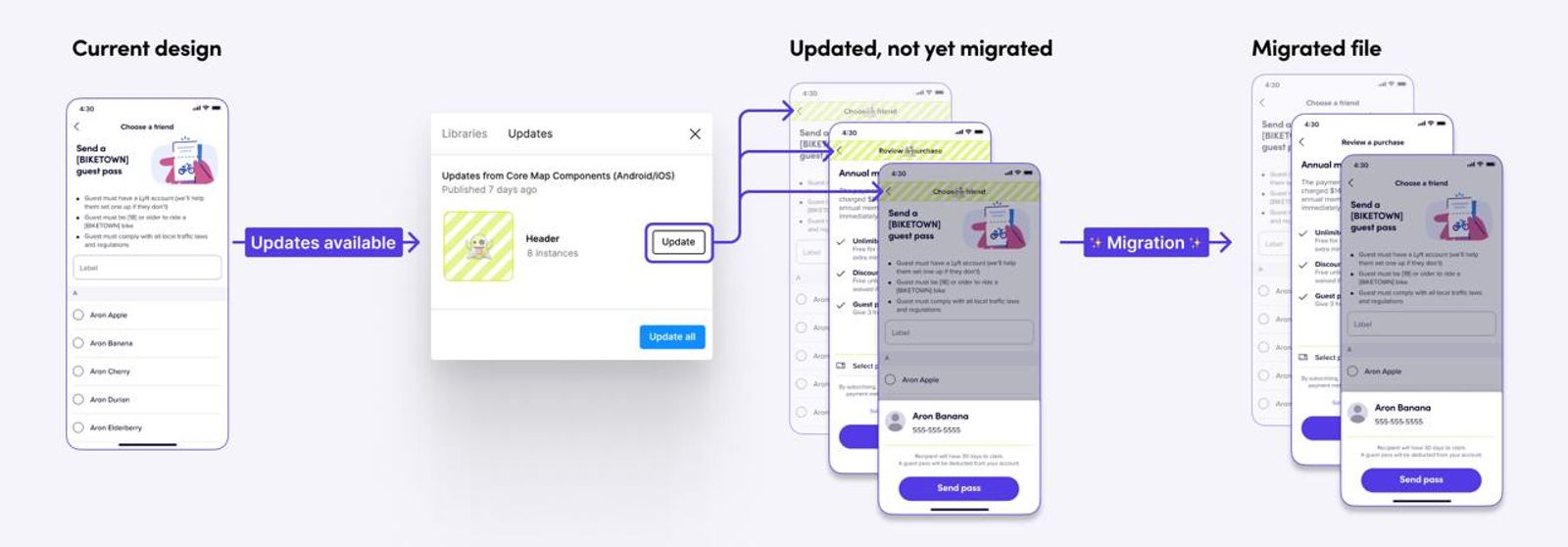
To be transparent, this is where trouble started. Midway through this project, the Product Design organization ceased to be — Lyft decentralized design, had a major reduction in force, and reorganized the entire product organization. Many of the designers assigned to migrate their team's sources of truth were suddenly no longer employed at Lyft. Those that remained were expected to fill in the gaps, leaving little time for migrations.
Thankfully, I'd set aside a month at the end of this project for me to assist with migrations directly. I handled the highest priority files (team-specific component libraries, for the most part).
The company's new direction had at least one silver lining: At this point, most teams were working on north-star, net-new work that did not rely heavily on older sources of truth.
These two factors combined allowed me to pull out of the nosedive and significantly improve adoption of the new component set.
Outcome / Impact
The goals of this project were to:
- Increase inserts of the new components (which were then unfinished and only adopted by a small percentage of eager users)
- Decrease detachments of instances
- Simplify component architecture, in order to improve library performance, reduce maintenance costs, and make components easier to interpret
- Increase goodwill amongst designers (as measured by "considered valuable" scores in our biannual LPL survey)
On three of four fronts, this project was a smashing success:
- Once the EOY deadline hit and the v1 components were fully deprecated, v2 component inserts grew to from 55% to 98% of total inserts
- Detachments also fell 72% (from 3.08% to. 0.87% of inserts)
- Variant count reduced by an average of 85%
However, the fourth result was surprising: our satisfaction scores actually sank for the first time in the history of LPL, from 94% to 92% of participants reporting that LPL was either "valuable" or "extremely valuable".
While the scores were still quite high, my hypothesis was that teams needed more targeted attention from systems designers in order to evolve the visual design of these components to better suit their visions. After all, these components had been static in their designs for nearly two years, and our feature designers were innovating and pushing the system's limits on almost every project.
This hypothesis directly informed the Design Foundation's strategy for the year of 2024, where we devoted 1/3 of each systems designer's work to embedding in high-priority feature teams to better understand their needs.
Words from my collaborators on this project

I've noticed that Mordechai has a very big focus on improving the LPL Figma library user experience.
He is able to notice annoyances in the library that add friction to designer workflows and actively calls them out and makes improvements using Figma's latest features.
I appreciate the videos he posts in the team Slack channel illustrating the optimization ideas he has as well. I think it's really great that Mordechai is thinking about the LPL libraries from a user point of view and thinking about optimizing designer workflows and reducing breaking Figma library updates as much as possible.

Most impressive of Mordechai's work is his project on Figma enhancements, the massive undertaking of which cannot be understated.
He has optimized and reworked many of our design system components to be more functional, user friendly, performant, and accurate. Not only that, but he expertly identified a rollout strategy to best deliver these updates across all of Lyft Product Design as to make migration as seamless and painless as possible for users. He has even created clear video walkthroughs recording himself performing migration to aid others.

Mordechai consistently delivers high quality design system solutions, collaborates closely with team members, acts as a resource for others, & drives initiatives that strengthen the design organization.
Of note, the Design Systems team lacks PMs (including DPMs & TPMs), so his project ownership entails roadmap prioritization, stakeholder management, & time management beyond what is expected of other product designers at Lyft.
Mordechai is an active participant in team discussions and has fostered strong working relationships with everyone on design systems. He consistently surfaces process improvements to help our teams work more efficiently, is the first to post about new tools/plugins, and even intuits what will expedite the work of the staff engineers on the team.
His ability to distill complicated migration flows into digestible & engaging short videos is exemplary and sets the standard for not just design systems but all of design at Lyft. He goes above and beyond for system users by not just responding to reported bugs & requests but proactively finding ways to make our libraries more efficient – all without fanfare.
Looking for more than a highly abbreviated case study?
Thanks for reading this far. Let's dig in deeper.
Get in touchMore work
App Launch Animation
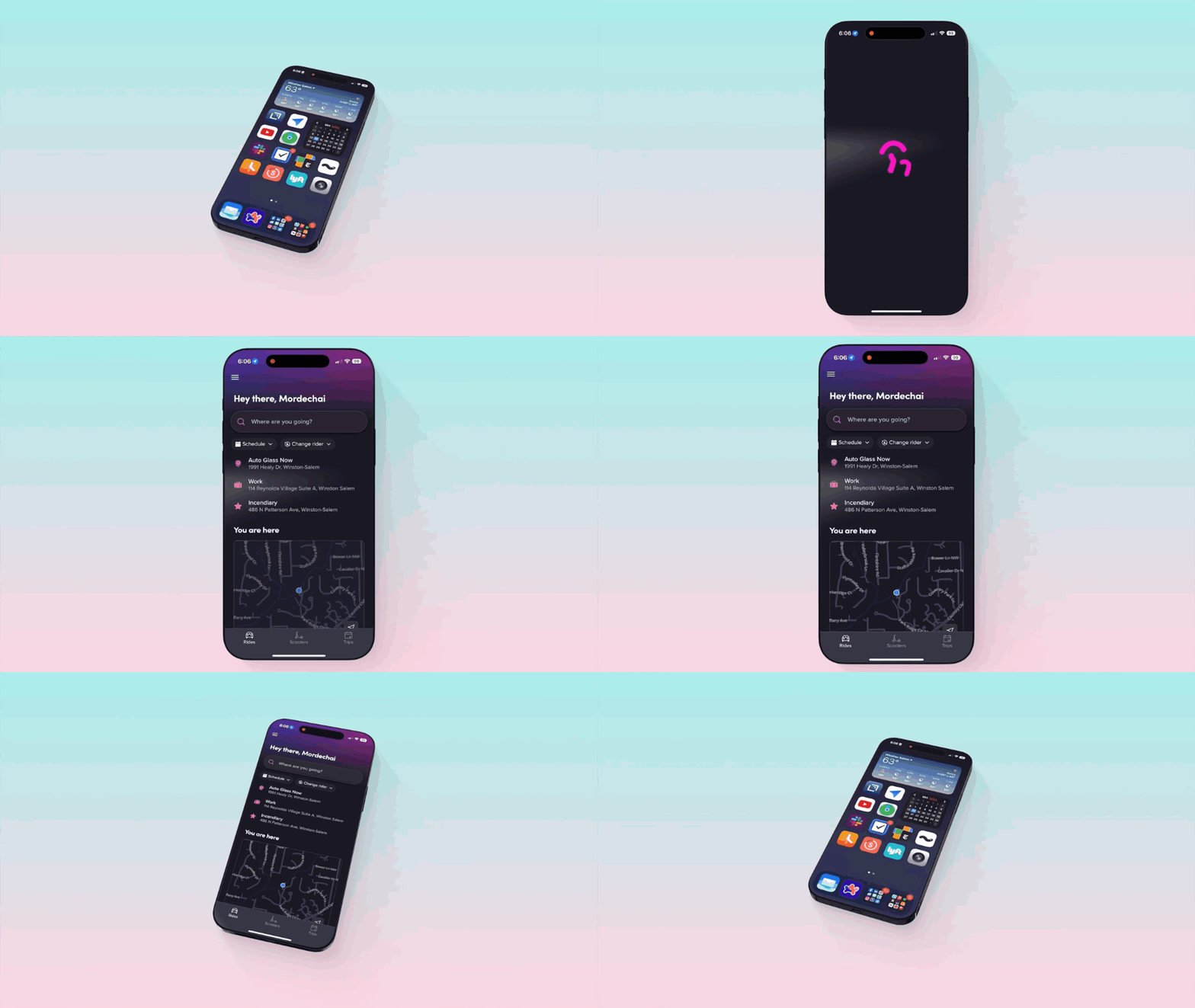
TLDR: In four weeks, I defined the scope, creative direction, and success metrics for a delightful app launch animation from an initially ambiguous request. I drove quick alignment across 10 stakeholders through daily comms, iterations, leading meetings and workshops.
Dev Mode Pilot
TLDR: I ran a large, cross-functional Dev Mode pilot at Lyft, demonstrating ~8k engineering hours / ~2.7k design hours saved per year. As a result, Dev Mode seats are now available to all front-end engineers at Lyft.